
Bremerton Previous Residents by Era
Different dates call for different records. The newest parcel card points to current taxpayer and property facts. Recorded deeds carry title changes. Directories and census schedules add the people who were listed at the address, while permits and maps date changes to the place itself. Start with the source closest to the target year, then bridge forward and back.
| Source | Years Covered | Where Held | What It Shows |
|---|---|---|---|
| EagleWeb deeds | January 1987 to present | Kitsap Auditor | Parties, recording date, parcel and legal description |
| City directories | Intermittent 1909 to 2009 | State Library catalog; ask KRL/PSGS | Listed names and addresses by volume |
| Telephone books | Intermittent 1941 to 2011 | State Library and local reference collections | Published name, phone, and address combinations |
| Federal census | Public schedules through 1950 | Archives and library databases | Household composition at one census date |
| Permit records | Approved electronic files from 2018; map from 2020 | Kitsap DCD or Bremerton by jurisdiction | Dated work, parcel, project, and applicant facts |
| Sanborn map | 1904, seven sheets | Library of Congress | Building footprint, material, use, and street pattern |
Owners are not always occupants, and directory listings are not complete household rolls. For previous residents, preserve the exact year and the role each source proves.
Anchor a Bremerton House Parcel
Enter the current address in Kitsap Parcel Details. Search the street name first, then add the house number. Record the parcel or tax account, site address, mailing address, taxpayer, sales facts, and legal description. The parcel is more stable than a street label and connects the assessor, map, permit, and recorder systems.
County guidance makes an important distinction: the taxpayer of record is not necessarily the legal owner. The deed index confirms title. A mailing address shows where tax mail goes, not who lived in the Bremerton house. These labels should remain separate throughout the previous-residents search.
The live assessor screen shows the parcel, site-address, and mailing-address search choices.
Use the resulting parcel number to avoid merging similarly numbered homes or old address spellings.
Walk Kitsap Deeds Backward
The Kitsap Auditor EagleWeb index begins in January 1987. It supports party names, dates, document number, parcel number, plat, lot and block, and legal-description fields. A grantor gives or transfers an interest. A grantee receives it. Those roles turn one deed into the next step backward.
- Find the present parcel and confirm the legal description in assessor records.
- Locate the current owner's purchase deed by party, parcel, or recording details.
- Record the grantor, grantee, date, document number, and legal description.
- Search the seller as a grantee to find the seller's earlier acquisition.
- Repeat to the January 1987 online cutoff, then continue through the Auditor or Archives.
- Chain of title
- The linked sequence of recorded transfers for one parcel.
- Legal description
- The recorded land description based on plat, lot, block, or survey geography.
- Related document
- An instrument that cites or changes an earlier recorded document.
Use EagleWeb's wildcard, Soundex, and Find Related options when names vary. Portal images are not certified copies. Auditor Recording offers office, phone, email, mail, and copy-form channels for help and certified records.
Earlier Bremerton Previous Residents
The January 1987 cutoff is an online boundary, not a loss of earlier deeds. Carry the parcel's legal description and latest known transfer to the Kitsap Auditor in Port Orchard. The office can route copy and search requests, while Washington State Archives and Puget Sound Regional Archives cover older county and local-government material. A focused Public Records Act request is another fallback when an agency has a known file that is not indexed online.
Do not jump from 1987 straight to a surname search. Plats, subdivisions, lots, blocks, and section-township-range descriptions can survive a changed street address. Search both parties and the land description. Keep the recording book, page, or document number whenever one appears.
Note: Kitsap's web index is updated as documents are recorded, but an online image still does not replace a certified copy.
Pair Bremerton Directories With Census
Deeds identify owners. To find who lived here before, place directory years around each transfer and compare them with the nearest public census. The State Library catalog verifies intermittent Bremerton city directories from 1909 through 2009 and telephone books from 1941 through 2011. The detailed collections and access issues are covered on the Bremerton city directory page.
- Choose the newest directory before the date being studied and search both surname and address sections.
- Write down each listed adult, spelling, initials, phone, occupation, and address exactly as printed, without assuming every field appears.
- Repeat in the next older and newer available volumes, allowing for gaps in the year run.
- Compare the nearest public census through 1950 for a household snapshot at one point in time.
- Test spouse names, nearby addresses, Manette, Charleston, and regional Bremerton listings when a household disappears.
A criss-cross directory means a street-first or address-first section that points back to listed names. KRL confirms local genealogy help and microfilm, but no exact public Bremerton reverse-directory title and run was verified. Ask the library or Puget Sound Genealogical Society rather than inventing shelf details.
KRL Finds Bremerton Past Residents
Kitsap Regional Library's genealogy service is the practical local fallback when an old name or address is not online. It offers Kitsap obituary requests, newspaper microfilm, Ancestry access inside the library, FamilySearch affiliate access, Fold3, and links to local custodians. The Puget Sound Genealogical Society collection at Sylvan Way includes noncirculating books, periodicals, census material, microfilm, microfiche, and local compendia.
Ask for a specific surname, address, and date range. A librarian can check a directory or telephone-book year, move to newspaper microfilm, and help locate an obituary. The State Library catalog remains the authority for the verified Bremerton year runs, but its volumes are on-site use and public access has been limited to Thursday appointments since the July 2025 closure.
See KRL's genealogy page before preparing a request. It shows the obituary and local research routes available to Bremerton families.
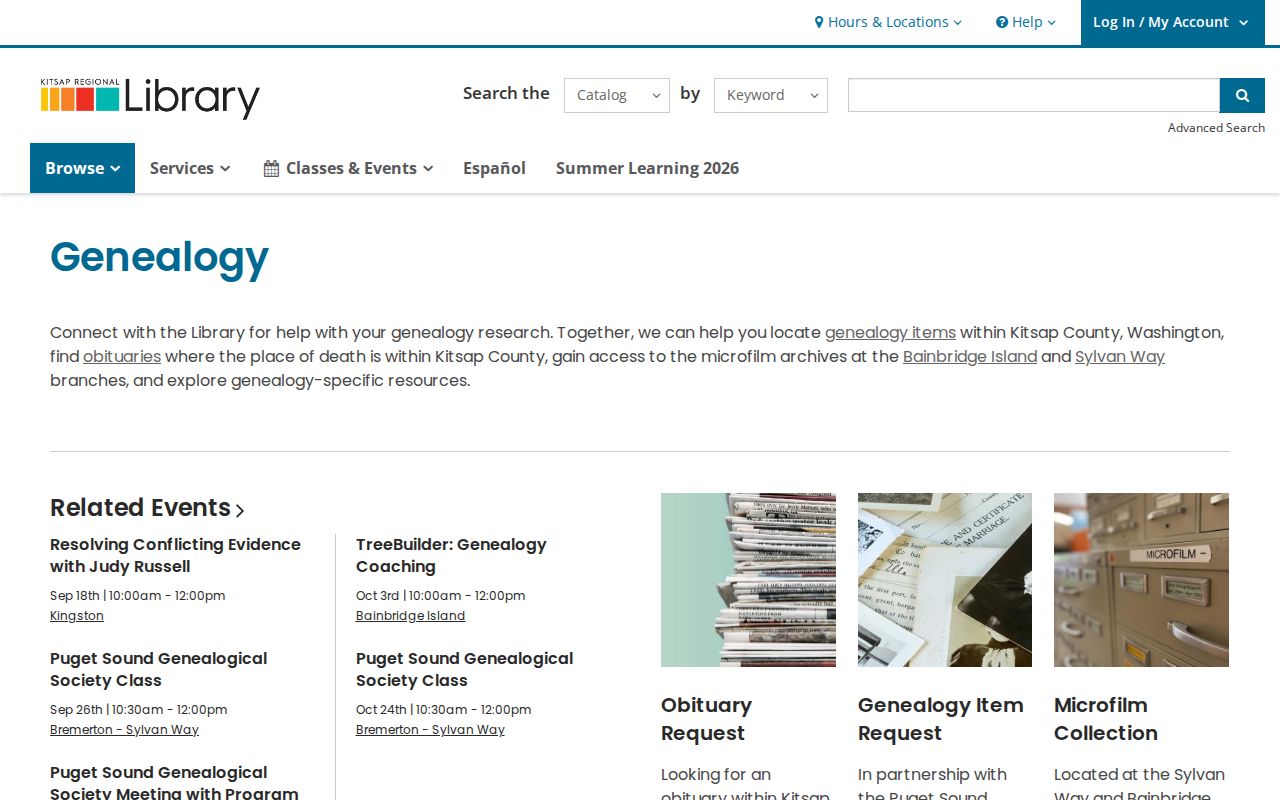
The library route adds occupants and life events that a deed chain cannot supply.
Map Bremerton in 1904
The Library of Congress 1904 Bremerton Sanborn map has seven public-domain sheets. It can show whether a structure stood on a lot, its footprint, construction material, use, and the block's street pattern. It cannot name an occupant. Pair a sheet with the plat, deed, directory entry, and newspaper item.
Sanborn evidence is strongest as a date bracket. A building shown in 1904 existed by the map survey, while a later permit may document alteration or replacement. Align the map block carefully because current house numbers and boundaries may differ. If a lot cannot be matched, return to the legal description instead of forcing a modern address onto the map.
Map limit. A building outline dates the site, not the person. Attach a name only when a separate dated record supports it.
Bremerton Address Names Changed
Local history changes how previous residents are indexed. William Bremer's townsite was platted in 1891, and Bremerton incorporated in 1901. Charleston began as Port Orchard No. 2 in 1891, was renamed Charleston in 1903, and later joined Bremerton. Manette grew from Captain William Renton's 1863 settlement and became part of later city geography.
Run older searches under Bremerton, Charleston, Manette, and Port Orchard. Early directory volumes often covered a region, and later editions included many nearby Kitsap communities. A missing name under modern Bremerton may be a catalog-label problem, not proof that the person moved. Preserve the older locality name in the citation.
The Navy Yard and shipyard drove rapid growth and shifts in household lists. Use directories, census schedules, deeds, and permit dates as separate evidence points. Local growth is context, not proof about a particular family.
Close Bremerton Household Trails
When a past resident disappears from directories, an obituary, probate file, cemetery entry, marriage record, or later address may close the trail. KRL accepts obituary requests. The Kitsap County Clerk holds Superior Court probate records and provides Digital Archives, Odyssey, copy, audio, phone, mail, and counter routes. Older transferred material may be at the regional archives.
The Washington Digital Archives also describes a Kitsap marriage collection covering 1860 through 2014. Search it as a life-event lead, then follow the record's named parties and date. Probate can connect an estate to heirs and property, but access varies by case and sealed material remains unavailable.
A Bremerton previous-residents timeline works best as a dated ledger. Put the parcel and legal description at the top, then add each owner transfer, directory appearance, census household, permit, and life event in order. Cite the keeper beside every entry. When two sources disagree, retain both readings and look for the original image or certified record. Do not smooth a spelling change or date gap merely to make the story look complete. That discipline keeps a past resident from being attached to the wrong Bremerton address and makes later review much easier.
Lawful use. Research Bremerton previous residents for family history, estate work, or care for a home's story. Never track or harass a living person.
Conflicting names should remain unresolved until another source connects the person, address, and date. The strongest trail states what each record proves and what it does not.